
Custom joinery Dubai: what a fair quote should contain
November 9, 2026 · 7 min read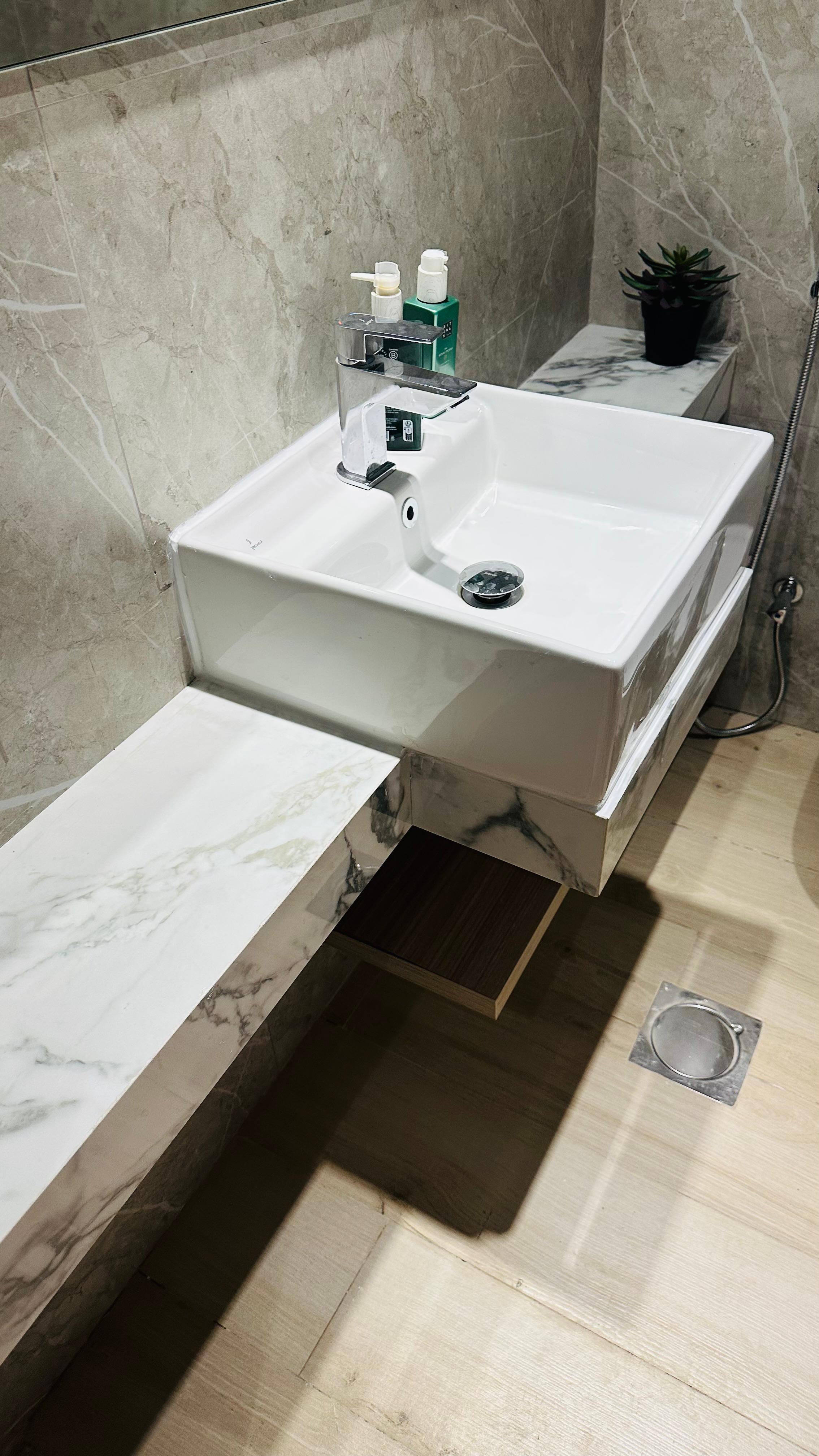
Custom joinery in Dubai means furniture built in a workshop from drawings you have signed, then delivered and fitted. It is not carpentry assembled in your corridor. A fair quote names the carcass material and board thickness, the hardware brand, the finish, and whether delivery, fitting and silicone sit inside the number. A single lump sum tells you none of that, and you cannot compare it to anything.
What custom joinery actually means in a Dubai villa or apartment
Start with the wall, not the furniture. Very few walls in Dubai are plumb, and fewer are square once a bulkhead has been dropped for ducting. Made to measure joinery begins with a survey of that specific opening: floor to ceiling at three or four points, corner to corner, and the position of sockets, water pipes and the AC drain.
Those numbers become full size shop drawings. The workshop cuts panels to those drawings, edges them, and pre-assembles what it can. The difference shows in the gaps. A unit built this way arrives with scribe fillers and plinths already cut for your wall, so the fitter closes the last 10mm with a panel rather than a tube of filler. That is the whole idea behind custom joinery in Dubai: the room is measured before anything is made, not during.
Where the joinery earns its money
Four places, in our experience of villa and apartment work.
Wardrobes. Built-in and walk-in wardrobes are the highest volume line because the shell of the room is fixed and every millimetre of internal depth decides what you can hang.
Kitchen carcasses and doors. We build custom kitchens built in our workshop, and the two halves need separate specification. The carcass takes the load and the moisture. The door takes the eye.
Vanity units under a stone top, where the cabinet has to be cut around the waste pipe and sit level under a counter templated by someone else.
Under-stair and hallway storage, and any unit that has to follow a curved or irregular wall. These are where site carpentry usually loses. The curve gets cut with a jigsaw and never quite repeats. Cut from a template in the shop, it does.
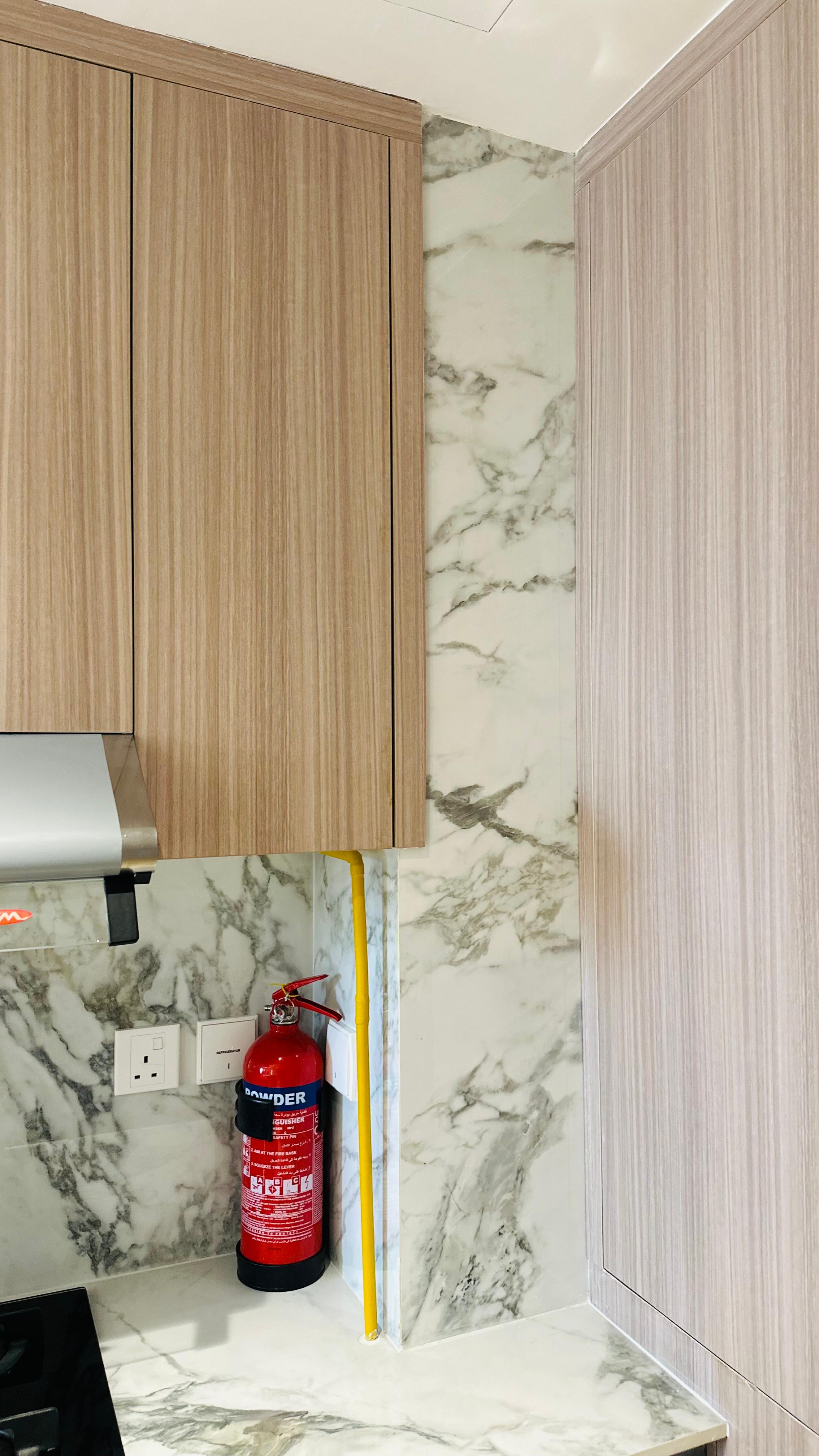 Kitchen carcasses and doors from our Jebel Ali workshop, fitted around the services you can see here, gas pipe and all.
Workshop-built and site carpentry are different jobs
Tolerance comes first. A panel saw or CNC holds a fraction of a millimetre on every cut. A circular saw on site does well to hold two or three millimetres across a two metre panel, and the eye sees that at the door gap.
Dust comes second. Cutting MDF in a finished apartment puts fine dust into every surface and the smell stays for days. In a workshop the cutting and edge banding run on machines with extraction, and only assembly happens in your home.
Ownership comes third, and buyers underestimate it. When a site carpenter makes a wardrobe 5mm short, someone has to decide who pays for the new door. When the workshop measured the wall itself, that argument does not exist. The workshop remakes the part. It is the reason bespoke joinery in Dubai is priced per job rather than per sheet of board, and the reason we ask to survey rather than work from your sketch.
Sanal and his team are very professional and easy to work with. Extremely good on timelines as well as wirh thie designs and experience. Also worked well within my budget. Kanchan Ramani, 5 stars
Our Google rating sits at 4.8 from 5 reviews, which is the number to check before you shortlist anyone, ours included.
What a fair custom joinery quote itemises
This is where to spend your comparison time. Two quotes for the same wardrobe can differ by a third and both look reasonable, because one is 18mm plywood with 2mm machine-applied edging and branded hinges, and the other is 16mm MDF with iron-on tape.
| Line on the quote | What the number should tell you |
|---|---|
| Carcass material and thickness | Plywood, moisture-resistant MDF or standard MDF, in millimetres, and where each is used |
| Back panels and shelves | Panel thickness, and whether shelves are fixed or adjustable on pins |
| Edge banding | Thickness, and whether it is machine applied |
| Hardware | Brand and model for hinges, runners, handles and lift-ups, or a stated allowance you can upgrade |
| Finish | Spray lacquer, veneer or laminate, number of coats, and where it is sprayed |
| Delivery and installation | Included or extra, and whether the old unit is removed and taken away |
| Silicone, filler and making good | Who does it, and whether it is already in the price |
The hidden line is almost always hardware or edging, because those are cheapest to swap after signature. If a supplier will not put the brand on paper, assume the allowance is the cheapest one in the catalogue and ask what the upgrade costs before you sign, not after.
From measure to install, and how to vet the workshop
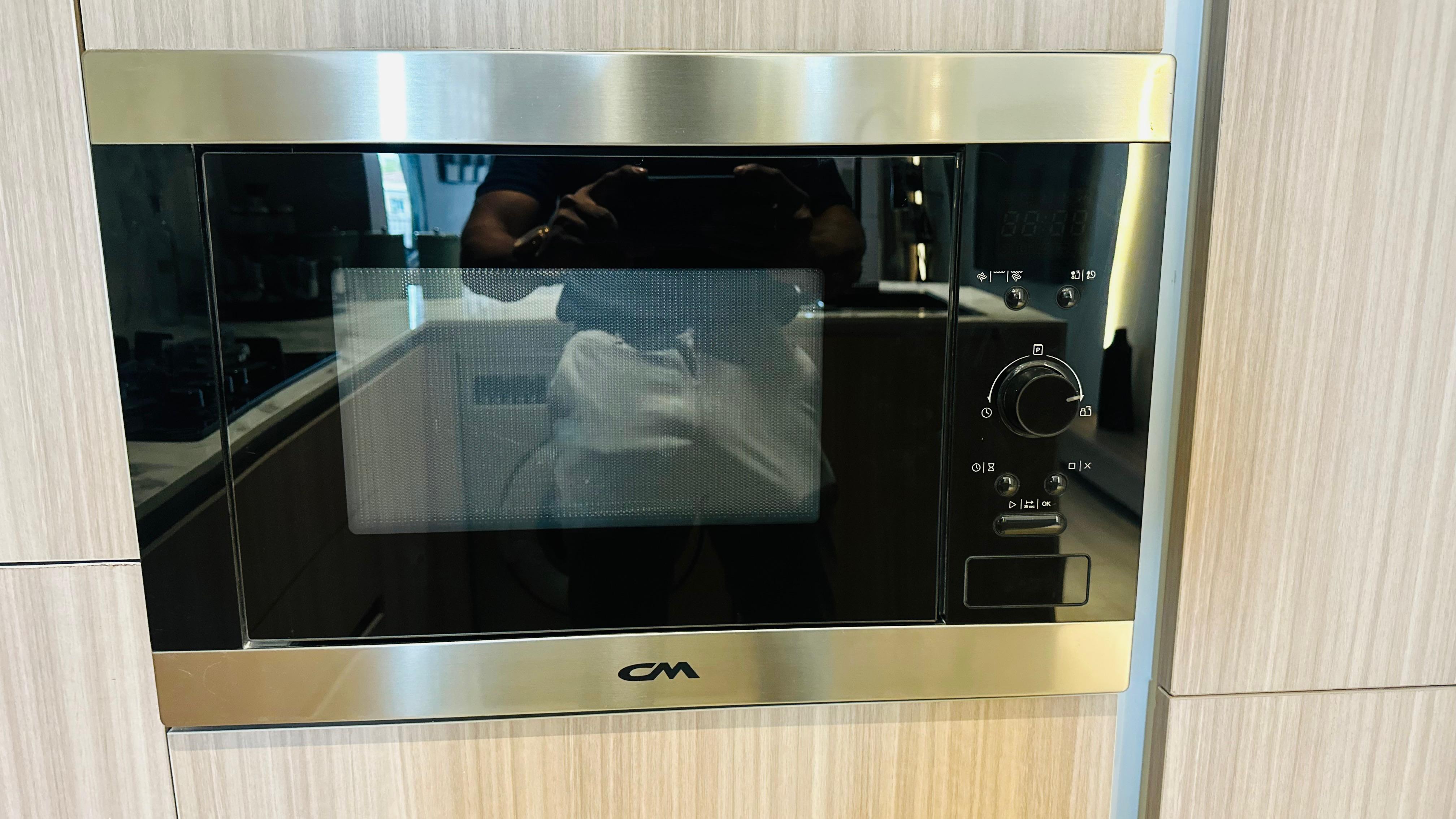 Appliance housings are drawn before a panel is cut, so the microwave sits flush in the run.
The sequence is short and unforgiving. Survey, then shop drawings you sign, then production, then installation. Handles, hinge type, drawer runners and internal layout have to be settled before production starts, because once a panel is cut and edged, a change means a new panel and a new delivery.
Vetting a workshop is a visit. Ask which machines cut the panels. If the answer is a hand saw, it is not a joinery workshop. Ask to see a project installed twelve months ago, not a showroom, and open a cabinet to look at the inside edges. Ask who fits the job, the workshop's own fitters or a subcontractor who arrives with the unit on a van.
We build in our own joinery workshop in Jebel Ali, which makes that visit a short drive into the industrial area rather than a promise. You can see the panel saw, the edge bander and the spray booth, and hold your sample next to the finish already in your home.
On a custom joinery villa project the sequence is identical, only longer, and approvals take the time rather than the carpentry.
To price your job, send photographs of the space from each corner, wall to wall and floor to ceiling measurements, the community or building name, and any developer drawings you hold. Tell us what has to go inside the unit, because a wardrobe with two hanging rails and one with six drawers are different jobs. WhatsApp is the fastest way to reach us on 0508570938, or book a workshop visit or a measured survey.
Frequently asked questions
How long does custom joinery take in Dubai?
The clock starts when you sign the shop drawings, not when you pay a deposit. From there it is production plus installation, and the honest answer depends on how many units and how unusual the finish is. A single wardrobe and a full kitchen with appliance housings are not comparable. Ask any workshop for a dated schedule in writing before you pay.
Plywood or MDF for carcasses?
Plywood or moisture-resistant MDF for kitchen carcasses, vanities and anything near water. Standard MDF is fine for dry bedroom and hallway units and holds a sprayed finish very well. The failure we see most is a cheap carcass under a wet area, not the wrong board in a wardrobe.
Can you match a finish I already have?
Usually yes, and the way to do it is a physical sample board, not a photo on a phone. Timber veneer is the hardest to match because grain and shade vary between batches. Spray lacquer and laminate match well if we can see the existing panel in daylight.
Do you need DET or DM approval for built-in joinery?
Internal fitted furniture that does not touch structure, drainage or the facade normally does not, though your building management will still want a delivery and work permit for lift and corridor access. Anything that moves a wall, alters a duct or changes the outside appearance needs approval, so confirm with your building or the authority before ordering.
Is a workshop visit worth the trip?
Yes, once, before you sign. Fifteen minutes in a working shop tells you whether panels are cut on a machine, whether edging is glued properly and whether there is a spray booth at all. Bring your drawings and your questions.
Planning a project in Dubai?
Tell us about your space and we'll come back with a plan and a price.
Get A QuoteWhatsApp Us